maandag 15 augustus 2016

FINRA Named One of the Best IT Employers for the 5th Consecutive Year

According to IDG’s Computerworld, FINRA ranks as one of the best places to work in information technology, specifically in the field of financial regulation. It is the fifth consecutive year that FINRA made it to Computerworld’s list of top 100 companies.

Computerworld’s Executive Vice President and Chief Information Officer Steve Randich said, “FINRA has a lot to provide technologists in terms of a chance to work in pioneering the causes of investor protection and market integrity. We’re proud that Computerworld has contributed to empowering technologists to produce and innovate in accordance to FINRA’s stable role in financial regulation.”

Randich cited as a prime example Comuterworld’s use of the cloud to make storage and processing of vast amounts of information scalable and safe. It has also included improved facility in performing regulatory analysis by technologists. He also said that producing open-source software and hosting hackathons has allowed their technology group in a dynamic environment, inside and outside the company. 

In this year’s list of Best Places to Work in IT, Computerworld had this to say about FINRA, “The employees at this independent, non-governmental regulatory office of securities companies are fully aware that their employer supports them a 100%.” He adds, “FINRA also provides ample parental leave benefits for child birth or adoption, gives a maximum of $5,000 for every child for adoption-related expenses, money for additional emergency support when regular child-care or elder-care is not available, and allows adjustable work schedules to aid workers balance their job and family concerns.

Moreover, FINRA gives workers two paid-vacation-days each year to do social outreach in their communities and their chosen charities.”

This year’s Best Places to Work in IT list have made it to the magical circle of organizations which have produced an innovative and fulfilling IT work environment,” stated Scot Finnie, Computerworld’s Editor-in-Chief. “In a highly competitive world of tech skills, these excellent employers can draw highly-talented IT professionals by offering attractive fringe benefits, fresh educational opportunities, utilization of cutting-edge digital systems and challenging, business-centered ventures.”

The Financial Industry Regulatory Authority (FINRA) is recognized as the biggest independent securities regulation agency for all firms operating in the United States. FINRA commits to safeguard the interests of the investor as well as the integrity of the securities market through efficient regulation and appurtenant compliance and technology-based systems. FINRA covers substantially every aspect of the securities market – beginning with registration and education of all industry players to evaluation of securities companies, writing regulations, enforcement of such regulations and the federal securities laws, and the education of the investing public in general. Moreover, FINRA conducts investigations and other regulatory tasks for equities and options markets, including trade updates and other related industry services. Finally, FINRA serves as the main administrator for resolutions of disputes for investors and securities firms.

donderdag 7 juli 2016

Heimdal Security Company: The Best Encrypted Messaging Apps You Can (and Should) Use Today


If you want to see all the best encrypted messaging apps in one place, then this is the guide you’re looking for.

We did a roundup of these encrypted apps because the battle for our data is fiercer than ever. Governments crave for it, companies seek access to it, and cyber criminals probably want it the most.

But what’s so special about my data?

The fact that it’s yours and it can be monetized one way or another, by any of the entities listed above.

Wake-up call: the data you share in your IMs

Today I’m going to focus on a big chunk of your data that I bet you disregard as unimportant: the information stored and share in instant messages and text messages.

Messaging, either via the Internet or through good, ol’ SMSs, is today’s go-to communication method. No doubt about it.

Younger generations – from Y to Z – would rather text than call someone at any time of day and night (myself included). And not only them. Employees in companies of all types and sizes are heavily using instant messaging apps as well.

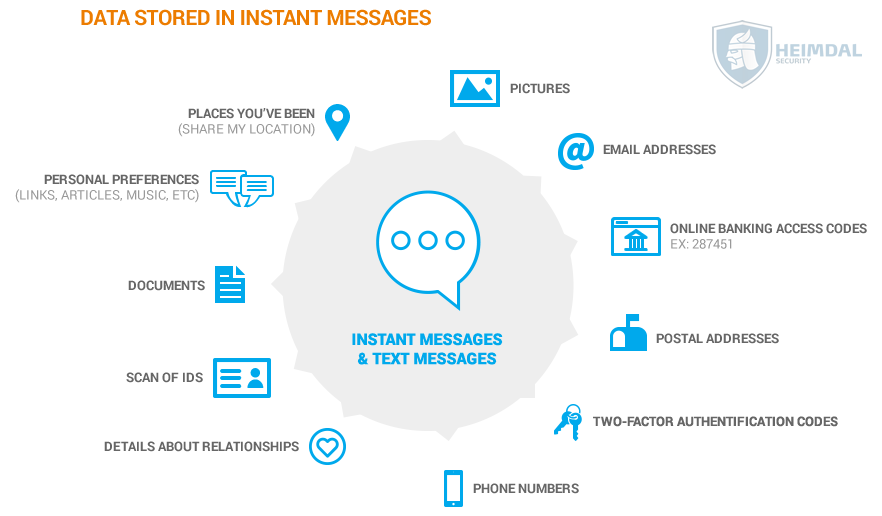
This means that a huge amount of data is stored, transmitted and shared through these messages.

Data like:


And this doesn’t happen only on mobile devices. Now instant messaging apps are cross-platform, so you can sync your conversation across your smartphone, tablet and desktop. Messaging apps also offer the option to be used for both online IMs and SMSs.

Everything is just a click or a tap away. But not only for you.

You may think you’re sharing data confidentially when using Facebook Messenger, Skype or Snapchat, but sometimes it’s just an illusion.

Without end-to-end encryption, your conversations are right in the crosshairs of cyber criminals, government meddling and amoral marketers.

Here’s a recent example of how security holes in these apps can expose your data to malware and other cyber threats:

“The Check Point security research team discovered a vulnerability in Facebook’s Messenger (both the online version and the mobile app) that would allow an attacker to modify the contents of someone’s chat history as well as give them the ability to spread malware through the chat service. […] This vulnerability existed because messages are normally stored on Facebook’s servers, and Facebook could also modify the messages itself if it so desired. The attackers are simply using a capability that Facebook already has. “

Do I have your attention now?

Good.

Because you’re going to want to find out about this. 

CONTINUE HERE to find out more…


donderdag 16 juni 2016

Adoption fraud - Irregular adoptions


Intercountry adoptions are very complex because they must follow laws set out by:
·         provincial and territorial governments
·         the Government of Canada, and
·         the country of adoption.

We make sure that immigration or citizenship requirements have been met before granting permanent status to an adoptive child. For more information on the process, read about CIC’s role

Be cautious – adopting a child from overseas can be complicated

Sometimes, prospective parents try to speed up the process by taking matters into their own hands. Although the vast majority of adoptions progress smoothly, adoptive parents should use caution throughout the process.

You should contact the government of the province or territory you live in to obtain the most up-to-date information about the adoption process, and to ensure that the adoption meets all their requirements.

To avoid unnecessary expense and disappointment, adoptive parents should not plan to return to Canada with the adopted child until they know for certain that all immigration or citizenship requirements have been met.

Don’t let this happen to you

The following stories are based on real experiences of intercountry adoptions. They are meant to demonstrate some of the problems that can arise in the process. These types of situations may be avoided by contacting your province or territory of residence to obtain the most up-to-date information about the adoption process.

Disclaimer

The families described are not real. The names are fictitious and the stories may combine details from several adoption cases.

Pierre and Maria’s story

Like many couples who decide to adopt, Pierre and Maria had been trying to conceive for several years.

They began the process of adopting a child overseas and were told they could be matched with a child in two years. But Pierre and Maria did not want to wait any longer to have a child, as they had already experienced such a long, frustrating and emotional journey.

A friend who worked in a hospital overseas told them about a baby who was abandoned by his mother and offered to help the couple adopt him. She assured Pierre and Maria that she had many contacts in the local government and could help them with the paperwork.

Pierre and Maria decided to bring the abandoned child to Canada in order to adopt him in their province. Over the next several months, they received pictures of the baby, furnished his room, and bought him clothing and toys. Pierre filled out many forms, including the CIC forms to sponsor the child for permanent residence in Canada, and his friend helped with the paperwork on the child’s end.

Once they thought all of the paperwork was in order, Pierre and Maria scheduled the next flight to the country where the baby was. The long-awaited moment to meet the boy had arrived, and their dream of having a family was about to come true.

Meanwhile at the local Canadian visa office, Janine, a visa officer had been working on the couple’s adoption file. Although Pierre and Maria had submitted what they thought was the necessary documents, Janine had serious concerns about the child’s history.

When Pierre and Maria arrived at the visa office with the child in tow, expecting to get a visa within days, Janine had to inform the couple of the visa refusal. She explained that without the proper documents, there was no way of proving that the child was legally available for adoption. She had no choice but to deny their application.

Stunned, disappointed and angry, Pierre and Maria returned home childless.

Stefan and Nicole’s story

Stefan and Nicole had been researching adoption agencies online for several months before selecting one that promised quick and efficient intercountry adoptions. Unbeknownst to Stefan and Nicole, many cases handled by their chosen agency were under investigation.

Stefan and Nicole eagerly proceeded with the adoption process and provided the agency with the necessary documents. Soon after, the agency informed the couple that they had been matched with a little girl. The agency mailed pictures to Stefan and Nicole, who were ecstatic to share their good news with family and friends. A few months later they received an update from the agency on the status of the adoption and they booked the next flight to meet the little girl and pick up her visa.

Upon arrival, Stefan and Nicole could not wait to meet the little girl and bring her back home with them to Canada. They arrived at the Canadian visa office, expecting to receive a valid visa for the child. The couple was completely shocked when the visa officer told them that the visa had not been approved.

The officer explained that the adoption file had been poorly prepared, the documents submitted were poorly translated and there were gaps in the information provided, which caused concern as to the circumstances surrounding the legality of the adoption. Devastated by this news, Stefan and Nicole were informed that they would have to re-submit certain documents through the host country’s judicial or adoption system. They were also informed that the process could take another few months. The officer would also need to investigate.

In order to avoid further disappointment and expense, the visa officer suggested that Stefan and Nicole wait to hear news from the visa office that all requirements were met before returning for the visa. 

After months of having waited for their little girl, Stefan and Nicole returned to Canada without her.

Seven months later, Stefan and Nicole received the news they had been waiting for. Their little girl’s visa was ready. They booked the next flight and were finally able to meet her. From that point the process went smoothly, and a week later Stefan and Nicole were back in Canada with their new daughter.

Elena and Brian’s story

Elena and Brian had been keen on adopting a child from within their province. They had started the preliminary work for the application process when they came across an adoption agency specializing in intercountry adoptions, which promised faster adoption times. Hopeful and eager to start their family, Elena and Brian turned to intercountry adoption.

The agency soon matched Elena and Brian with a two-year-old girl and assured them a quick and simple process. They were told that they could expect to bring the little girl home in less than six months. Excited by this news, Elena and Brian spent the next months completing the necessary home study, gathering the required documents, finalizing the financial commitments, and getting their house ready in time for the child’s arrival.

A week before the flight to go meet the child, Elena and Brian contacted the Canadian visa office to ensure the paper work was complete. They were then told that the file was not ready and that it was under investigation.

The visa office told them that there were concerns with the accuracy of the information provided on the birth certificate as well as serious concerns about how the child had come to be available for adoption, and that they were looking into the possibility of child trafficking. The visa office explained that in cases of potential child trafficking, additional verifications must be done to ensure the best interests of the child are respected.

Under the impression that the child had been abandoned as an infant, Elena and Brian were shocked by the news that this may not be the case. They later found out that many other adoptions from that particular country were also being held up or suspended because of fraud and child trafficking concerns.


maandag 13 juni 2016

Human Capital Alliance Inc. Thailand, Singapore - The Nation: Finding world-class management

A top human resources executive tells KI Woo how companies are building global-class infrastructures.


Building infrastructures that can help companies compete successfully against global competitors is fast becoming a top priority.

Acquiring, and more importantly, keeping the best talent is now viewed as a critical ingredient for building a sustainable and profitable business.

Edwin Sim, president and CEO of Pathfinder Asia Ltd and its affiliate Human Capital Alliance Ltd, said that as companies begin riding the economic recovery and become highly profitable again, they are all seeking ways to sustain growth by upgrading their management and operational infrastructures.

“Most companies are now saying they must further professionalise their operations,” he said.

After decades of establishing strong bases in Asia , many local family companies are now aiming to build sustainable global businesses and realise that they must develop appropriate infrastructures that will first attract and then retain top management talent.

A key infrastructure ingredient is developing an appropriate internal corporate culture that will attract management leaders. “Top professional business leaders thrive best in high-performance, meritocratic organisations,” he said.

The economy now features many large, family-controlled companies that are gradually evolving into professionally run organisations. These companies are constantly wrestling with issues such as how to meld the best Western management practices with Asia ’s unique culturally influenced business environment, he said.

Pathfinder Asia Ltd and Human Capital Alliance, he said, are led by experienced United States and Canadian-trained professionals who spent their formative education and business years in North America before returning to Asia .

“Our people have the ability to recognise and bridge the gap between Western management practices and the unique requirements of Asian family companies,” he said.

The key to developing successful global management practices in Asia and particularly in Thailand is knowing how to combine pragmatic, analytical-based Western business strategies with holistic Asian practices that emphasise balance and harmony.

“Successful Asian companies of the future will be those that can efficiently and effectively meld the best of both worlds,” he said.

Another key element is identifying and then dealing with the unique needs of a company’s stakeholders. An Asian family company’s stakeholder structure is in most cases much more complex than its Western counterpart.

A major reason for the difference is the family’s inherent influence in Asian cultures. “Family is business and business is family”.

In most Western companies, stakeholders are limited to their shareholders, management team, employees, communities and customers. However, in Asian companies, family relationships strongly influence stakeholders’ interactions.

“Stakeholders in Asian companies may simultaneously belong to several stakeholder groups, each representing a diverse range of often-competing interests,” he said.

For example, a family company’s management team may include executives in key functions throughout the company.

These executives are also share-holder/stakeholders. “These managers/shareholders’ interests in the company may have resulted from marriage to the founder’s children or grandchildren or nieces and nephews,” he said.

Any successful transition from a traditional family-run company to a professionally run company requires identifying and dealing with each company’s unique stakeholders’ interests before pragmatically applying the latest Western management practices, he said.

A CEO of an Asian family company, who may putatively control the board and may even represent the family bloc that controls a majority of the company’s shares, may not be able to act similarly to a Western company CEO because of these unique family relationships and the need to maintain balance and harmony.

“Thus the successful implementation of pragmatic Western-based business processes and the building of modern global-class business management infrastructures in many cases must be complemented with an acute awareness of the unique internal culture of most Asian companies,” he said.

Thailand has developed a strong core of top senior managers, who have been trained locally and overseas by major multinational companies, that can help major companies compete globally.


“Many top professional business managers are now realising that large, local family-owned companies may indeed now be where they can best maximise their own personal potential,” he said.

woensdag 1 juni 2016

Cybersecurity Fraud Intelligence Lead – Vice President in J.P. Morgan, Singapore

The Cybersecurity organization's objective is to ensure that JPMC is able to effectively detect, prevent, and respond to cyber threats against our technology infrastructure. The scope of Cybersecurity comprises detection and monitoring of threats and vulnerabilities, managing security incidents, and evolving our preventive infrastructure to keep ahead of the threat. We accomplish this through strong information security leadership and active collaboration with line of business information risk managers to provide high quality security solutions and services that are focused on improving the Firm's risk posture.

The Cyber Fraud APAC and South America Lead will work closely with Fraud Intelligence teams within Cyber Security Operations to maintain and advance intelligence collection efforts, optimize reporting, and manage metrics production.

Responsibilities :

·         Lead efforts across Fraud Intelligence teams (card, banking, data automation) to expand the teams' intelligence collection, optimize reporting to internal stakeholders, and assist in managing expanding metrics production efforts specific to the Asia Pacific and South American geographic areas
·         Act as the Fraud Intelligence lead representative in a multi-disciplinary security operations center (SOC)
·         Act as liaison between Corporate Cyber Security Operations-Fraud Intelligence and the various JPMC lines of business (LOBs)
·         Work closely with Cyber Security Operations teams to collaborate on a first in class intelligence program.
·         Maintain and advance knowledge of industry fraud trends
·         Conduct and manage detailed analysis and risk assessments on all issues affecting the Firm
·         Engage in problem solving, process improvement, and strategic planning initiatives
·         Continually identify and evaluate 3 rd party solutions to fraud problems facing the Firm
·         Author and edit intelligence reports and contribute to metrics production


Qualifications

5+ years of experience with at least 3 collecting and analyzing intelligence, conducting financial investigations, and/or working in banking technology, risk, or operations including APAC and South America

·         3+ years of experience collecting and analyzing intelligence, conducting financial investigations, and writing professional reports
·         Experience with large volumes of transactional data, conducting deep-dive analysis, and financial services industry products and services
·         Experience serving business stakeholders, managing cross collaboration, and leading teams
·         Strong knowledge of banking terms, phrases, and concepts
·         Prior cyber security and/or cyber threat experience a plus
·         The ability to work in a fast paced environment to include the translation of complex concepts and issues into messaging easily understood by senior leadership
·         Bachelor's degree or equivalent experience
·         Prior threat intelligence/SOC experience a plus

People Skills:

·         Excellent people, time management, and organization skills
·         An ability to work with minimal direction and supervision-independently or in leadership role
·         Experience managing aggressive deadlines in a fast-paced environment
·         The ability to coordinate, work with, and gain the trust of business stakeholders to achieve a desired objective

Process Skills:

·         Strong attention to detail in conducting analysis combined with ability to accurately record full supporting documentation
·         An ability to leverage the efforts of multiple teams into a cohesive product/service
·         An ability to mitigate a vulnerability or issue by leveraging support from internal stakeholders in a collaborative approach
·         An ability to conduct critical analysis, form a hypothesis, and make recommendations to senior management
·         An ability to mitigate a vulnerability or issue by leveraging support from internal stakeholders in a collaborative approach

Communication Skills:

·         Excellent written and verbal communication skills are required
·         Able to articulate and visually present complex analysis results
·         Ability to communicate effectively with business representatives in explaining findings clearly and where necessary, in layman's terms

This position is anticipated to require the use of one or more High Security Access (HSA) systems. Users of these systems are subject to enhanced screening which includes both criminal and credit background checks, and/or other enhanced screening at the time of accepting the position and on an annual basis thereafter. The enhanced screening will need to be successfully completed prior to commencing employment or assignment.


J.P. Morgan is a place for talented people from all backgrounds and perspectives because our clients come from all backgrounds and perspectives. We encourage a culture of inclusion, where everyone's opinion counts and all employees have the freedom to deliver their absolute best. This is why we work hard and invest in attracting and developing a diverse workforce. Learn more about our Business Resource Groups in how they help our employees build successful careers and reach their greatest potential.

woensdag 4 mei 2016

Hill & Associates Ltd Hong Kong Security Risk Management

Operating in a volatile business environment means challenges can spring up without warning. Deep local knowledge allows us to react swiftly and effectively, no matter where, how or why the crisis has arisen.


·         Carry out a series of threat, vulnerability and risk assessments across a portfolio of hotels
·         Design and train crisis management plans for relevant business risks covering information or cyber security, fires, floods, medical emergencies, earthquakes, civil unrest and bomb/terror threats
·         Manage security and logistics for a corporate event with thousands of attendees
·         Protect personnel during periods of transition, downsizing and restructuring
·         Assess locations and evaluate facilities’ access points, perimeter and environment
·         Provide comprehensive crisis planning, training and including risk assessments for many international schools across Asia


Crisis Management
- Risk Assessment & Contingency Planning
- Crisis Management Training & Support
- Business Continuity Risk Management

Operations & Facility Risk
- Threat, Vulnerability & Risk Assessment (TVRA)
- Security Review
- Technical Security Design
- Capital Projects Risk Management
- Supply Chain Risk Management
- Technical Surveillance Countermeasure (TSCM) Services

Travel & Event Risk Management
- Risk Assessment & Review
- Travel Facilitation & Support
- Venue and Event Planning & Support
- Executive, Personal & Family Protection

Corporate Intelligence

Counterparty Risk
- Due Diligence and Investment Appraisal
- Strategic & Market Intelligence
- Executive Profiling and Vendor Screening
- Pre-Employment Screening
- Shareholder Action Services
- Litigation Support


Integrity Risk
- Fraud & Compliance Risk Training and Management
- Fraud and Corruption Enquiries
- Litigation Support

Brand & IP Risk
- Risk Assessment and Controls Review
- IP & Trade Secret Protection
- Intelligence Gathering and Analysis
- Program Design and Enforcement Actions


·         GIS (Global Intelligence Service)
·         Country Risk Reports
·         Commissioned Reporting

Cyber Security

Cyber / Information Security
- Incident Response and Planning
- Bespoke Advisory Services
- Risk Assessment, Controls and Security Review
- Technical Security Design
- Cyber Situational Awareness
- Threat Intelligence
- Training and Workshops

- Perimeter & System Hardening and Application Security Testing
- Penetration Testing and Vulnerability Assessments
- Digital Due Diligence, Expert Witness Services
- Computer Forensics and Digital Preservation
- Data Recovery and Secure Destruction

zondag 20 maart 2016

Mossack Fonseca apoya carrera de Amcham


La cinta costera fue el marco propicio para la carrera corporativa que organizó Amcham. Conscientes de la importancia de que correr es salud, MossackFonseca se une por segundo año consecutivo a esta iniciativa, la cual tiene como objetivo desarrollar la conciencia al deporte empresarial, promoviendo actividades en familia.

Fundada en 1977, el grupo de Mossack Fonseca es una empresa global que proporciona servicios de contabilidad fideicomiso y legal integral.

Con más de 500 miembros en cada continente, grupo Mossack Fonseca ofrece excelentes servicios basados en más de 35 años de experiencia. Como parte de su valor añadido, el grupo ofrece asesoramiento personalizado y una experiencia en línea de clase mundial a través de un Portal virtual del cliente que está disponible 24 horas al día. Nuestra aplicación cliente información Portal web permite a los clientes de las empresas en línea, verificar el estado de las empresas y pagar las facturas, además de otras transacciones.

Nuestro servicio y profesionales orientados a la investigación se especializan en servicios de confianza, gestión de patrimonios, estructuras de negocios internacionales y derecho comercial, entre otras áreas.


Nuestra cartera de productos y servicio es constantemente actualizado y renovado, lo que permite al grupo a encontrar la solución adecuada para su negocio. Ofrecemos investigación, asesoramiento y servicios para las siguientes jurisdicciones: Belice, Países Bajos, Costa Rica, Reino Unido, Malta, Hong Kong, Chipre, Islas Vírgenes Británicas, Bahamas, Panamá, anguila británica, Seychelles, Samoa, Nevada y Wyoming (Estados Unidos).